

Why choose us?
Since 2006, Swallow Electronics has been a trusted source for Public Address System Speaker.
We manufacture and export Ceiling Speakers, Wall Speakers, Ball Speakers, Garden Speakers, Horn Speakers, Column Speakers, Megaphones and related audio products.
Professional Team
19 years of production experience, 13 years of export expertise, and a skilled team with 15+ years in speaker manufacturing.
Quality Control
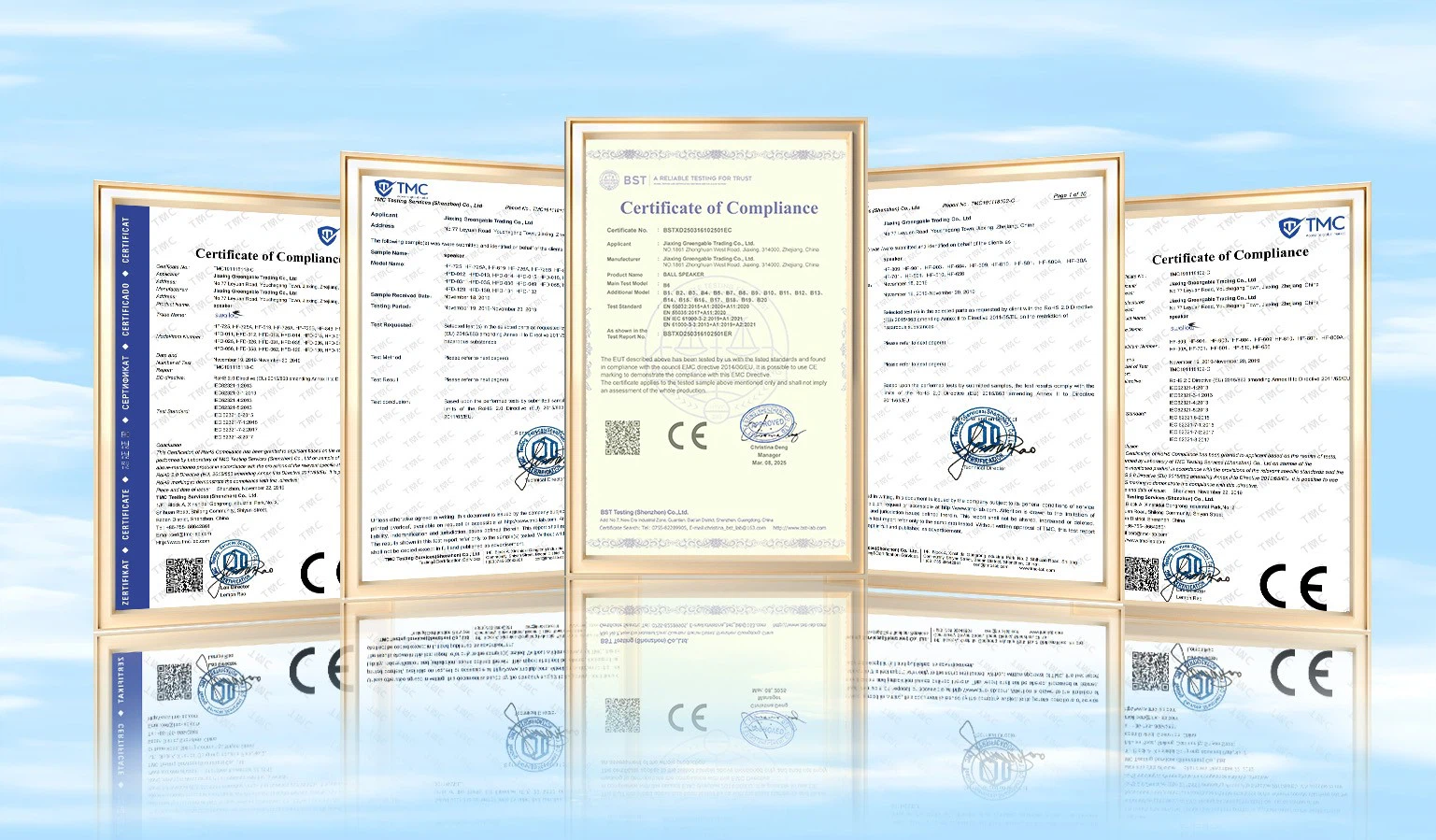
Strict quality control, professional quality inspection and testing equipment; all products are CE & RoHS certified.
Fast Response
Professional technicians and service teams are online 24 hours a day, and respond quickly within 5 minutes.
Customized Service
Accept ODM/OEM service, 24-hour tailored solutions, fast prototyping, and quick delivery.
-
![Coaxial Ceiling Speaker]() Coaxial Ceiling Speaker200mm (8in.) 2-WAY COAXIAL IN CEILING SPEAKERModel:C1Short Description:Rated power:10W/20W/30WInput Voltage:70V / 100VSpeaker Driver: 8 woofer + 1 tweeter
Coaxial Ceiling Speaker200mm (8in.) 2-WAY COAXIAL IN CEILING SPEAKERModel:C1Short Description:Rated power:10W/20W/30WInput Voltage:70V / 100VSpeaker Driver: 8 woofer + 1 tweeter -
![Fireproof Ceiling Speaker]() Fireproof Ceiling Speaker125mm (5in.) Metal Fireproof Ceiling SpeakerModel:C54Short Description:Rated power:1.5W / 3W / 6WInput Voltage:70V / 100VSpeaker Driver: 5
Fireproof Ceiling Speaker125mm (5in.) Metal Fireproof Ceiling SpeakerModel:C54Short Description:Rated power:1.5W / 3W / 6WInput Voltage:70V / 100VSpeaker Driver: 5 -
![Bluetooth Ceiling Speaker]() Bluetooth Ceiling SpeakerModel: BC3. Rated power:20W. Bluetooth Version: 4.2. Frequency range: 70Hz-20kHz. SPL(@1W/m): 88dB.
Bluetooth Ceiling SpeakerModel: BC3. Rated power:20W. Bluetooth Version: 4.2. Frequency range: 70Hz-20kHz. SPL(@1W/m): 88dB. -
![Enclosed Ceiling Speakers]() Enclosed Ceiling SpeakersModel: C18M. Rated power: 3W. Input voltage: 70V / 100V. Frequency range:110Hz – 20kHz. SPL(@1W/m): 88 ± 3dB.
Enclosed Ceiling SpeakersModel: C18M. Rated power: 3W. Input voltage: 70V / 100V. Frequency range:110Hz – 20kHz. SPL(@1W/m): 88 ± 3dB. -
![in Ceiling Stereo Speakers]() in Ceiling Stereo SpeakersModel: C59. Rated power: 80W. Input voltage: 8Ω. Nominal Impedance: 32Hz – 20kHz. SPL(@1W/m): 90 ± 3dB.
in Ceiling Stereo SpeakersModel: C59. Rated power: 80W. Input voltage: 8Ω. Nominal Impedance: 32Hz – 20kHz. SPL(@1W/m): 90 ± 3dB. -
![in Ceiling Home Audio Systems]() in Ceiling Home Audio SystemsModel: C58. Rated power: 65W. Input voltage: 8Ω. Nominal Impedance: 45Hz – 20kHz. SPL(@1W/m): 90 ± 3dB.
in Ceiling Home Audio SystemsModel: C58. Rated power: 65W. Input voltage: 8Ω. Nominal Impedance: 45Hz – 20kHz. SPL(@1W/m): 90 ± 3dB. -
![Coaxial in Ceiling Speaker]() Coaxial in Ceiling SpeakerModel: C57. Rated power: 35W. Input voltage: 8Ω. Nominal Impedance: 60Hz – 18kHz. SPL(@1W/m): 90 ± 3dB.
Coaxial in Ceiling SpeakerModel: C57. Rated power: 35W. Input voltage: 8Ω. Nominal Impedance: 60Hz – 18kHz. SPL(@1W/m): 90 ± 3dB. -
![Ceiling Speaker 3 W]() Ceiling Speaker 3 WModel: C56. Rated power: 3W. Input voltage: 100V. Frequency range: 90-16KHz. SPL(@1W/m): 87dB.
Ceiling Speaker 3 WModel: C56. Rated power: 3W. Input voltage: 100V. Frequency range: 90-16KHz. SPL(@1W/m): 87dB. -
![in Ceiling Audio Speakers 65W]() in Ceiling Audio Speakers 65WModel: C55. Rated power:65W. Nominal Impedance: 8Ω. Frequency range: 45-20KHz. SPL(@1W/m): 88dB.
in Ceiling Audio Speakers 65WModel: C55. Rated power:65W. Nominal Impedance: 8Ω. Frequency range: 45-20KHz. SPL(@1W/m): 88dB. -
![Wireless Active in Ceiling Speakers]() Wireless Active in Ceiling SpeakersModel: BC2. Rated power:40W. Nominal Impedance: 8Ω. Frequency range: 90-16KHz. SPL(@1W/m): 91dB.
Wireless Active in Ceiling SpeakersModel: BC2. Rated power:40W. Nominal Impedance: 8Ω. Frequency range: 90-16KHz. SPL(@1W/m): 91dB. -
![Bluetooth Active Ceiling Speaker]() Bluetooth Active Ceiling SpeakerModel: BC1. Rated power:40W. Nominal Impedance: 8Ω. Frequency range: 80-18KHz. SPL(@1W/m): 91dB.
Bluetooth Active Ceiling SpeakerModel: BC1. Rated power:40W. Nominal Impedance: 8Ω. Frequency range: 80-18KHz. SPL(@1W/m): 91dB. -
![5" Flush Ceiling Speakers]() 5" Flush Ceiling SpeakersModel: C52. Rated power: 3W/6W. Input voltage: 100V. Frequency range: 90-16KHz. SPL(@1W/m): 90dB.
5" Flush Ceiling SpeakersModel: C52. Rated power: 3W/6W. Input voltage: 100V. Frequency range: 90-16KHz. SPL(@1W/m): 90dB.


What are Ceiling Speakers?
Ceiling speaker, also known as an in-ceiling or architectural speaker, is a speaker designed to be mounted flush or surface-mounted within a ceiling, offering a low-profile and space-saving audio solution. Ceiling speakers are generally passive, which means they do not have built-in amplifiers and require power via a speaker cable that's connected to an external amplifier.
Benefits of Ceiling Speakers
- Space-Saving Design:Installed flush into the ceiling, saving floor and wall space for a clean and modern look.
- Wide Sound Coverage:Evenly distributes sound throughout the room, perfect for background music and announcements.
- Aesthetic Integration:Blends seamlessly with any interior, maintaining a minimalist and clutter-free environment.
- Customizable Audio Setup: Can be paired with multiple speakers to create a surround sound experience.
- Can Be Controlled Remotely:You don't need to adjust the volume manually, you can do it from a specific app or even using Bluetooth connection.
- Ideal for Various Applications: Used in homes, offices, hotels, shopping malls, restaurants, and public spaces.
What Are the Different Types of Ceiling Speakers?
- Passive Ceiling Speakers – These speakers cannot be directly linked to audio equipment; instead, they require an additional amplifier for power. Because you may select the appropriate amplifier to fit, they are therefore perfect for bigger commercial areas or locations that demand high-quality sound.
- Active Ceiling Speakers – All you have to do is connect the active ceiling speakers to an audio source because they come with an integrated amplifier. They work well for background music or smaller locations with a tight budget, and they are simple to install.
- Full-Range Ceiling Speakers – These speakers provide a full sound experience by covering a broad frequency range, from low to high. They are ideal for medium-sized venues where additional bass subwoofers are not required, such as restaurants or conference rooms.
- Subwoofer Ceiling Speakers – These focus on low-frequency sounds, enhancing the bass. They are typically used alongside full-range speakers in places like home theaters, concert venues, or large commercial spaces to provide deep bass effects.
- Two-Way or Three-Way Ceiling Speakers – These speakers have different drivers for different sounds. Two-way speakers have one for bass and one for treble. Three-way speakers add a middle-range driver for clearer sound, especially in the mid and high tones.
- Waterproof Ceiling Speakers – These speakers can handle moisture, making them great for bathrooms, pools, and outdoor spaces. They're built with special materials to keep water out and keep working in damp areas.
- Integrated Audio System Ceiling Speakers – These speakers work with smart audio systems, offering features like Bluetooth, WiFi, and tuning systems. They are perfect for modern homes, smart offices, and retail spaces.
How Do Materials Make a Difference in Speaker Construction?
As with anything, the whole can only be as good as its parts.
In our world, the world of super-duper-awesome-high-fidelity sound reproduction, this principle is paramount.
We could spend hours discussing the many reasons we selected each of the small components that make up our speakers, but today, we want to talk about what are arguably, and we do mean arguably, the most important pieces of all: the speaker cones!
Since the job of the speaker cone is to essentially take the vibrations from the speaker's voice coil and turn them into audible sounds for your listening pleasure, the speaker cone must be able to accurately reproduce those vibrations without distorting. For this reason, even-tempered and consistent materials are required; in a perfect world, a speaker cone should be very rigid and durable, but also lightweight and capable of starting and stopping vibrations on a dime.
Imagine the speaker is the human vocal mechanism; if the speake's voice coil is the lungs, then the speaker cone is the vocal cords and mouth. That said, the shape of your mouth, the strength of your vocal cords and the muscles that control them, as well as your ability to quickly start and stop making noise, all play a role in how well your voice projects through the environment and how high/low your voice can go.
Speaker Cone, Usually made of:
- Polypropylene (durable, moisture-resistant, good for general use)
- Kevlar (lightweight, strong, and high-performance)
- Aluminum (rigid, provides clear sound)
- Paper (lightweight, warm sound but less durable)
Speaker Frame (Basket): Usually metal, such as aluminum or steel, for durability and stability.
Grille:
- Aluminum (lightweight, rust-resistant)
- Steel (strong but can rust if not treated)
- Plastic (ABS) (lightweight and corrosion-resistant, often used for moisture-prone areas)
Enclosure (if applicable): Some ceiling speakers have back enclosures made of plastic, wood, or metal to improve sound performance and prevent sound leakage.
Magnet: Typically ferrite or neodymium, with neodymium being stronger and more compact.
▂▂▂▂▂▂▂▂▂▂▂▂▂▂▂▂▂▂▂▂▂▂▂▂▂▂▂▂▂▂
How to Install a Ceiling Speaker?
Installing a ceiling speaker requires choosing a suitable location, cutting the ceiling, wiring, fixing the speaker unit, and adjusting the sound quality.
1. Pick the Right Spot
First, find a spot on the ceiling where you want the speaker. Make sure there are no wires, pipes, or beams in the way. Also, keep a little space from the walls.
2. Cut the Hole in the Ceiling
You need to use a drill and the right tools to cut a hole in the ceiling. Make sure the hole is the right size for the speaker to fit.
3. Wiring
- If you're using passive speakers, you'll need to run a speaker cable from the amplifier to the speaker.
- If you're using active speakers, you'll need to connect both the power cable and the audio cable.
4. Install the Speaker
- Mount the Bracket: If your speaker has a bracket or frame, attach it to the ceiling securely.
- Hook Up the Cables: Plug in the audio and power cables. For active speakers, don't forget the power cable. For passive speakers, connect the speaker cable to the amplifier.
- Put the Speaker in Place: Slide the speaker into the hole and secure it with screws, clips, or spring clips (depends on the model). Some speakers just snap into place with spring clips.
5. Test the Sound
Connect your audio source (like an amp or Bluetooth device) to the speaker. Play something and test the sound. It should be clear with no buzzing or distortion.
6. Finish Up
- Cover the Edges: If the hole doesn't look perfect, cover it with trim or a decorative panel.
- Grilles: Many speakers have grilles that you can paint to match your ceiling, so they blend in.
▂▂▂▂▂▂▂▂▂▂▂▂▂▂▂▂▂▂▂▂▂▂▂▂▂▂▂▂▂▂
How many in-ceiling speakers do I need?
The exact number of in-ceiling speakers you need depends on a few things, starting with the size and layout of your room. You can adequately cover most small rooms (up to 150 square feet) with only a pair of speakers. For larger rooms (up to 500 square feet), you may need six or more speakers.
But it isn't just square footage that matters.
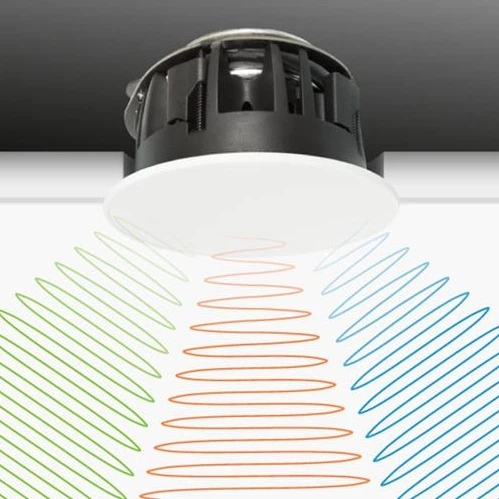
Speakers project sound outward in a V shape, which means that the further away they are, the more space they cover. So, in-ceiling speakers can cover more area in a space with 14-foot ceilings than they would in a space with 8-foot ceilings, because the sound waves have more room to travel outward before they reach the height of the listener's ears.
Other considerations may factor in, too. For example, if you only want in-ceiling speakers to cover the section of a room in which your home theater is installed, you can likely get away with only a pair of in-ceiling speakers installed on either side of your seated location. And if you want a multi-room audio setup, consulting a professional is probably your best bet. They'll be able to advise on the type, number, and size of speakers that would be optimal for your space.
What size in-ceiling speakers do I need?
Another factor that determines how many speakers you need? The size of the speakers themselves. Most ceiling speakers come in a 6"or 8"size, with the larger size usually offering a wider coverage angle, deeper bass, and a louder maximum volume.
It's also possible to mix speaker sizes within the same configuration.
What are the best brands of Ceiling Speakers?
Most manufacturers of conventional wall mount speakers will usually manufacture a range of ceiling speakers also. Popular brands are Electrovoice, Bosch, Apart, RCF, Bose, JBL, to name but a few. These are all market leaders in this field. However there are many brands at lower price points that offer excellent value for money, such as Adastra, Clever Acoustics, Pulse Audio. Again, the quality and cost of the Ceiling speaker need to be considered depending on the application (does quiet, background music need a top-quality speaker?) and the budget that has been set aside for the install.
How to cooperate with us ?
If customers want to cooperate with Swallow Electronics Factory, they can follow these steps:
Inquiry & Product Selection
Customers can visit www.loudspeakerchina.com or contact info@loudspeakerchina.com to check available ceiling speakers, wall speakers, horn speakers, and other products.
Provide specifications, quantity, and customization requirements (OEM/ODM, logo, packaging, etc.).
Quotation & Sample Confirmation
Swallow Electronics will provide a quotation based on the request.
If needed, samples can be arranged for testing. Sample cost and shipping fees will be confirmed.
Order Confirmation & Payment
Once the sample is approved, the customer confirms the order details (model, quantity, price, lead time, payment terms, etc.).
Payment terms: Usually T/T (Bank Transfer), L/C, or negotiable terms.
Production & Quality Control
The factory starts production after receiving the deposit/payment.
Strict QC process ensures the products meet CE & RoHS standards.
Customers can request third-party inspections if needed.
Packing & Shipping
Speakers are packed as per the customer’s requirements (standard or custom packaging).
Shipping by sea, air, or express (DHL, FedEx, UPS, etc.), based on customer preference.
After-Sales Support
Warranty & technical support are provided.
If any issues arise, the factory will help solve them promptly.
Products Description
Our Factory
Swallow Electronics Factory, established in 2006, specializes in manufacturing and exporting high-quality audio products, including ceiling, wall, ball, garden, horn, and column speakers, as well as megaphones. With a 3,800 sqm workshop, 12 injection molding machines, and a monthly output of 50,000pcs, we ensure efficient production. Our experienced team, with 15+ years of expertise, guarantees excellence in OEM & ODM services, including custom designs, logos, and labels. Supplying to Europe, the USA, the Middle East, and South America, our CE & RoHS-compliant products meet global standards. Committed to quality, service, timely delivery, and competitive pricing, we aim to build lasting partnerships based on trust and satisfaction.

FAQS
1.What do I need to run ceiling speakers?
All ceiling speakers need to be powered by an external amplifier which is connected to each ceiling speaker using speaker cable. For the best multi-room solution, we recommend the Amp.
2.Do ceiling speakers need a subwoofer?
Ceiling speakers don't require a subwoofer to provide a great sound quality, however adding a subwoofer can dramatically improve your experience by filling in the lower frequencies, adding significant depth to your music.
3.Can you get Bluetooth ceiling speakers?
There are two main types of wireless ceiling speakers that you can get - Bluetooth and WiFi. Bluetooth speakers have a built-in receiver that allows you to pair a suitable smart device, such as a smartphone or tablet, and stream audio wirelessly at a close distance in a single room.
4.Should ceiling speakers be mono or stereo?
We always recommend using pairs of standard mono ceiling speakers for rooms bigger than 3 metres x 3 metres, but for some solutions such as bathrooms and small bedrooms where space is limited a single stereo speaker is an ideal option.
5.Can you hook up speakers without a receiver?
If your TV or Cable box has left and right RCA outputs you can use that to feed a simple amplifier and speaker setup or just some Self-Powered speakers. Note that cable box output will only allow the speakers to work for Cable and not other inputs.
6.What is the difference between 2 way and 3 way ceiling speakers?
A 3-way speaker has 3 different dedicated components designed to individually handle bass, vocals, and high frequency effects, making it a full-range speaker. A 2-way speaker has only two components, one tweeter for the midrange and one woofer to handle both the mid-range (vocals) and the bass frequencies.
7.What size ceiling speaker do I need ?
Before you decide on how many to install, you need to work out what size of speakers will fit your room best.
Here are the most common ceiling speaker sizes and where they’re used:
4” speakers: ideal for smaller rooms or for creating a more spaced out, even spread of sound in a larger room
6” speakers: the best of both worlds, these are perfect for any situation, deliver a wide frequency range, and will suit most installations
8” speakers: for those who need more audible quality, these bring a much stronger mid- and low-frequency range
8.What are the disadvantages of ceiling speakers?
Cons of In-Ceiling Speakers
In-ceiling speakers can be more difficult to install than in-wall speakers, especially in retrofit applications. Because they are mounted in the ceiling, the installation process can be more complicated and may require professional assistance.
9.How far off the wall should ceiling speakers be?
18-24 inches away.
In-wall and ceiling speakers should be installed at least 18-24 inches away from an adjacent wall or ceiling.
10.Where is the best place for ceiling speakers to be positioned?
When installing a single stereo speaker, it is best to place it in the center of the ceiling for the best distribution of sound. When installing two or more speakers, the optimal placement is at an equal distance from each wall in the room and at least six feet away from each other. For unconventional room layouts, speakers with angled or pivoting tweeters work best.
11.Are ceiling speakers IC rated?
In ceiling speakers do not have an IC or Non IC rating the way recessed cans so. You can safely place insulation directly on top of the speakers. Use caution if the material is blown insulation as it will fill the basket.
12.What gauge speaker wire is best for ceiling speakers?
For most home theater systems, 16-gauge wire is all you'll need. However, if your speakers are more than 50 feet away from the receiver, stepping up to 14-gauge isn't a bad idea. Also, if you're using a high-current amplifier or lower-impedance speakers, 14-gauge is best.
13.What is the best layout for ceiling speakers?
It is best to position the ceiling speakers at equal distance apart from each wall, along the length of the room and at least 2 metres away from each other for the best stereo separation effect.
14.Why do my ceiling speakers crackle?
There are a few causes behind speaker buzzing and crackling, but it's mostly about the connection between your output device and speaker. Cables, amplifier issues, loose connections, damaged internal components, or excessively loud volumes can all cause this.
15.Should ceiling speakers be angled?
Horizontal spacing should be about the same as the horizontal separation of the left and right speakers. If overhead speakers offer a wide (45 degrees or more) dispersion pattern, they should point directly downward; speakers with narrower focus should be angled toward the primary listening position.
16.How do you distribute ceiling speakers?
The most common distribution rule is: the distance between two speakers should be greater than 2.5 times of the distance from a single speaker to a person's ear when standing. The distance for a broadcast system can be farther. For conferences, the sound pressure must be closer.
17.Are ceiling speakers a fire hazard?
The rule to follow is: Fire hoods are required if the ceiling speaker is installed in or adjacent to habitable rooms or within a location of access or escape.
We're well-known as one of the leading ceiling speakers manufacturers and suppliers in China. Please feel free to buy customized ceiling speakers made in China here from our factory. For quotation, contact us now.
multi room ceiling speakers, music ceiling speakers, small ceiling speakersPopular Products


